 Skip-the-line available
Which SHIBUYA SKY window to book for sunset
Tokyo sunset moves from about 16:28 in early December to 19:01 in late June. Here is the entry window to ask for in every month.
Sunset is the reason most people go up to SHIBUYA SKY, and it is the reason the evening windows sell out. But sunset in Tokyo moves by more than two and a half hours across the year, and the deck's entry windows are only 20 minutes long. Pick the wrong one and you either stand in the wind for two hours or arrive as the light has gone. This guide gives you the sunset time for every month and the window to ask for.
Sunset in Tokyo, month by month
These times come from the National Astronomical Observatory of Japan's sunrise and sunset tables for Tokyo in 2026. They are for sea level; from 229 metres up, the sun stays in sight for a few minutes longer. On the day we checked, the deck's own site gave a sunset time three minutes later than the sea-level table.
January: 16:38 on the 1st, 16:51 on the 15th. February: 17:08 and 17:22. March: 17:36 and 17:48. April: 18:02 and 18:14. May: 18:27 and 18:39. June: 18:51 and 18:58. July: 19:01 and 18:57. August: 18:46 and 18:31. September: 18:09 and 17:49. October: 17:26 and 17:06. November: 16:46 and 16:35. December: 16:28 and 16:29.
The earliest sunsets come in late November and early December, at about 16:28. The latest come around the end of June and the start of July, at 19:01. Spring and autumn move fastest: in September and October the sunset comes about two minutes earlier every day, so the table's figure for the 1st is noticeably off by the 30th.
The window to ask for
Aim for an entry window that starts 40 to 60 minutes before sunset. That allows time to pass through the gate on the 14th floor, ride up through the Sky Gate, use the lockers on the 46th floor and climb to the roof, with enough time left to find a place before the light changes.
In practice: in January, ask for about 16:00. February, 16:20. March, 17:00. April, 17:20. May, 17:40. June and July, 18:00. August, 17:40. September, 17:00. October, 16:20. November and December, 15:40. In the second half of the faster-moving months, shift a window earlier.
All of these windows sit in the Sunset band, which starts at 15:00. The earliest sunsets of the year are still more than an hour after that, so even in December you do not need the Daytime fare to catch the sun going down.
If you can only get a later window than you wanted, take it if it starts before sunset. The best colour often comes in the 15 to 20 minutes after the sun has gone, as the sky turns and the city lights come on.
Why not just arrive at sunset
Because the roof is busiest at exactly that moment. Everyone with a sunset window converges on the west side, where the sun goes down, and the best places along the glass go to the people already standing there. Arriving 40 minutes ahead gives you the choice.
There are also steps between the gate and the roof that take time. The lift ride through the Sky Gate is quick, but on 46 you need to store everything that cannot go outside: bags, hats, tripods, selfie sticks, earphones, food and drink. At busy times the lockers have queues.
And there is no re-entry. If you arrive early and find you are cold or hungry, the 46th floor has a cafe and bar, Paradise Lounge, and you can go back down there without leaving the deck.
Where to stand on the roof
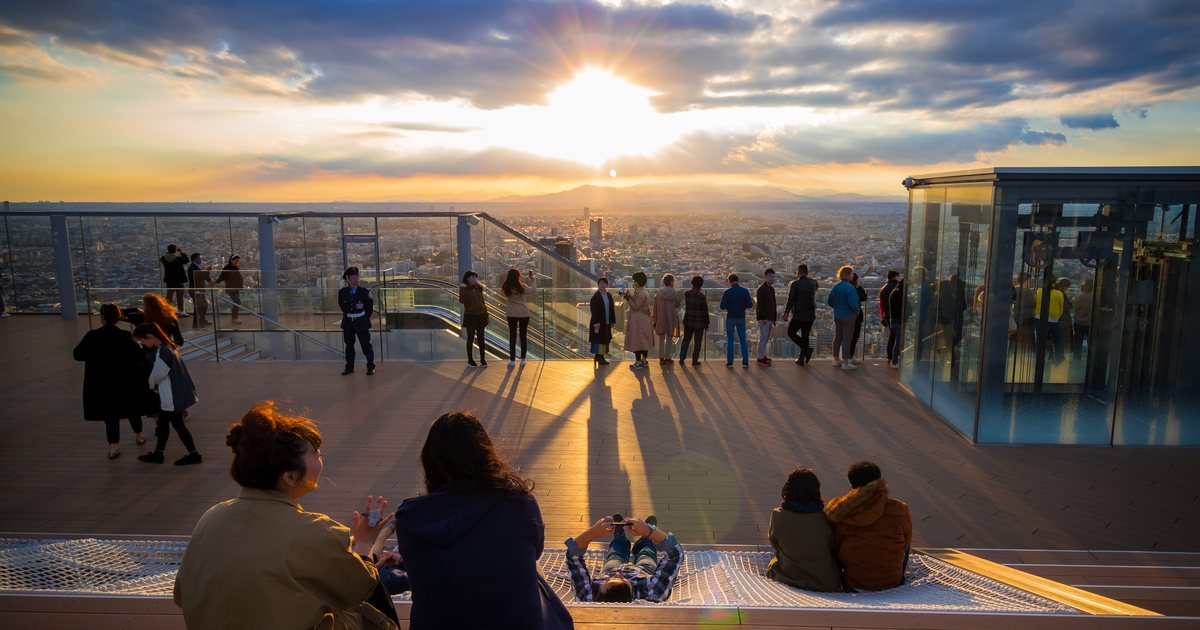
The sun sets in the west, which from Shibuya means across the low-rise sprawl of Setagaya and Suginami towards the mountains. On a clear day Mount Fuji sits in that direction, and in the winter months, when the sun sets further to the south-west, it goes down in the same part of the sky as Fuji.
The glass-walled edge runs right around the roof, so you can stand at the barrier anywhere. The wide steps rising to the helipad lawn make a natural grandstand facing the light, and many people sit there. The lawn at the top gives the highest vantage point on the deck.
Once the sun has gone, turn around. The east side has Tokyo Tower, Roppongi and, further off, Tokyo Skytree, and they light up as the sky darkens. The Sky Edge corner looks straight down on the Scramble Crossing, which is at its brightest after dark.
What each season looks like
Winter, from December to February, gives the clearest air of the year. It is the best season for seeing Mount Fuji and for long views generally. It is also cold and windy up on the roof, and the sun sets early, around 16:30 to 17:20.
Spring, from March to May, brings later sunsets and milder evenings, but often haze. Visibility varies from day to day. Summer, from June to August, has the latest sunsets, around 18:30 to 19:00, warm evenings and frequent haze; extreme heat can close the roof, and so can thunder.
Autumn, from September to November, sees sunsets move quickly earlier and the air start to clear again. October and November are popular with visitors, and those sunset windows are among the hardest to get.
Staying for the night view
There is no time limit inside, and the deck stays open until 22:30, so a sunset window easily becomes an evening. After the sun goes, the city comes on piece by piece: the office towers of Shinjuku to the north, Tokyo Tower in orange to the east, the neon of the streets below.
From 19:00, the roof's Crossing Light sends columns of light up into the sky every hour and half hour. The show changes with the season. If your sunset falls well before 19:00, it is worth waiting for at least one.
In season, the deck also runs a rooftop bar on the Sky Stage, THE ROOF SHIBUYA SKY; its sofa seats need a separate ticket from the deck. Paradise Lounge on the 46th floor is open to anyone with an entry ticket.
Photographing the sunset
The roof's glass wall is high and clear, and on a bright evening it barely registers in a photograph if you hold the lens close to it. As the light fades, the glass starts to reflect the people and lights behind you; press the lens against it, or shade it with your hand, and the reflections disappear.
Tripods, monopods and selfie sticks are not allowed on the roof, so for low-light shots, rest the camera on the handrail or brace it against the glass. Phones with a night mode do well here. A camera must be on a neck strap or fit in a pocket, and the camera bag stays in a locker on the 46th floor, so put spare batteries and cards in your pockets before you go up.
For people pictures, the wide steps up to the helipad lawn make a natural stage: shoot towards the sun and your friends turn into silhouettes against the sky, or turn away from it and the low light falls full on their faces.
After sunset, walk to the Sky Edge corner and look down: the Scramble Crossing fills and empties under the lights, and a few seconds of exposure turns the crowds into streaks.
Building the rest of the day around it
A sunset window falls in the late afternoon or early evening, so the rest of your day can be spent nearby. Harajuku and the Meiji Jingu shrine are one stop north of Shibuya on the JR Yamanote Line, and the forest around the shrine is the green block you will see from the roof. Omotesando is a walk away.
Shibuya itself has more than enough for an afternoon, and the buildings around the station, Shibuya Scramble Square included, are joined to it, so you can stay close to the entrance without watching the clock. Aim to be at the 14th floor at the start of your window.
After dark, the deck stays open until 22:30. Many visitors go down after the Crossing Light and straight into dinner in Shibuya; others stay up for the late-evening view when the roof thins out.
When the sunset windows are sold out
This is the common problem. Each date goes on sale two weeks ahead, and the sunset windows are often gone within days. When we looked in late October 2026, sunset was sold out on twelve of the next fourteen days.
You have three real options. One: book the latest window still open before sunset, even if it is earlier than ideal, and wait on the roof or in the lounge. Two: book a Daytime window and stay on, which works if you are happy to spend a long afternoon up there. Three: hold your preferred window with us. People cancel, places return to sale, and we watch for them and email you if one opens.
What does not work is turning up and hoping. When the adult windows are sold out online, the counter on the 14th floor has none to sell.
If the weather turns
The roof closes at short notice for strong wind, rain, snow, thunder, photochemical smog warnings and extreme heat. When it does, the indoor Sky Gallery on the 46th floor stays open, with its floor-to-ceiling glass facing the same view. A sunset through glass is not the same, but it is still a sunset over Tokyo.
The deck posts the roof's status on its website and its X account through the day. Check before you set off. The deck gives no refunds or discounts once you are inside, whatever the weather does. If the forecast for your date looks poor, write to us before your window and we will tell you what the deck is reporting.
Cloud alone does not close the roof. A grey evening can still give a good night view, and sometimes the best colour comes when there is a break in the cloud along the horizon.
Frequently asked
What time is sunset at SHIBUYA SKY?
Between about 16:28 in late November and early December and 19:01 around the start of July, according to the national observatory's Tokyo tables. From 229 m the sun is visible a few minutes longer.
How early should I arrive for sunset?
Book a window that starts 40 to 60 minutes before sunset. That gives you time for the lockers and to find a place on the roof.
Is the Sunset fare needed to see the sunset?
Practically, yes. Every sunset of the year falls after 15:00, when the Sunset band starts. A Daytime ticket only works if you go up before 15:00 and wait.
Can I see Mount Fuji at sunset?
On clear days, yes, in the west. Winter gives the best chance; summer haze often hides it.
What if sunset is sold out on my date?
Take the latest window still open before sunset, take a daytime window and stay on, or hold the date with us so we can watch for cancellations.
Is it worth staying after sunset?
Yes. The city lights come on in the half hour after the sun goes, and from 19:00 the Crossing Light beams rise from the roof every half hour.